
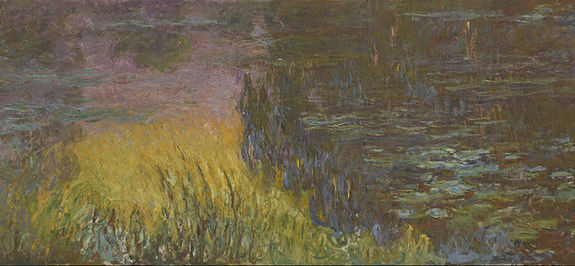
In 1909, Claude Monet confessed that along with his water lily pond, tended by no fewer than five gardeners, his landscapes of water and reflections had become his greatest undertaking and his main source of inspiration.
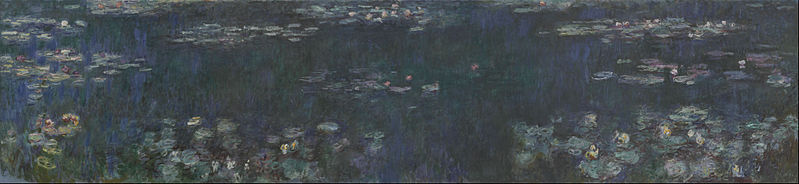
Monet (Paris, 1840 – Giverny 1926) grew these plants in his famous water garden, presided over by the emblematic Japanese bridge, which he had laid out in 1893 on his property in the French village of Giverny, where he spent the last years of his life. He took an interest in every variety of water lily, and especially in the white ones. In his final period, an almost blind Monet painted the magical shapes of his water lilies over and over, and they became the absolute protagonists of one of his masterpieces, created between 1914 and 1926. A work he gave to France to celebrate its victory in the First World War.
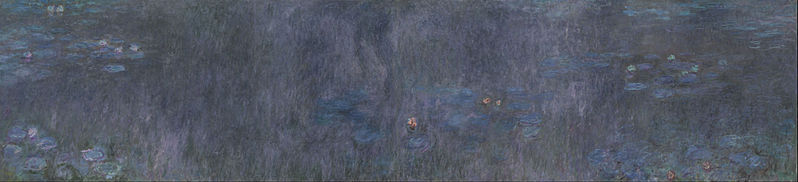
It was a hugely ambitious project. He hoped to give shape to the sensory experience of that enveloping setting in large, delicate murals which, slightly curved, would surround the viewer and plunge him into an extraordinary simulated reality, a calm illusion without end. To do so, he put together twenty-two panels made up of eight canvases: four represent dawn and the other half dusk; two metres high, and if they were lined up side by side they would stretch almost a hundred metres wide.
The spectacular decorative ensemble, which André Masson called “the Sistine Chapel of Impressionism”, unfolds a landscape of water full of water lilies, branches, reflections, trees and clouds. Monet stopped worrying about the horizon and the sky in order to concentrate on small areas of the pond, working almost in the foreground. He let a uniform surface prevail, with no point mattering more than any other.

That neutrality is heightened by the square format of the compositions, which gives them the quality of the infinite, of the limitless. Reinforced even further by the unfinished look of the edges left unpainted. An aspect that would have a strong influence in the second half of the 20th century, above all on American artists.

The truth is that the Frenchman's brushwork had never been so free, so removed from any objective description of forms as it is here. And if you look at the pieces up close, the impression is one of total abstraction, both in identifying the plants and in their own reflections, and the viewer has to make an effort to put the landscape back together.

Monet's idea was to install his Nenúfares in the Musée de l'Orangerie, where they can still be enjoyed today. That space struck the artist as the perfect place for an encounter between nature and natural light. Monet got involved in organising the display of his work, planned for an oval room built that way to reinforce the immersive visual effect he was after. He never saw the result, though, since the museum opened in May 1927, months after his death on 5 December 1926.

Comments (1)
Candela Ruiz
May 20, 2020Log in to leave your comment. Log in