
You'd probably never stopped to think about it, but now that it's dawned on you, you can't stop running through each of your favourite paintings in your head. How many times have you shared your love for certain artworks by Rembrandt, Munch or Van Gogh with other people? Maybe, if you're one of those who refuse to be like everyone else, you've gone for Pollock or DelaCroix. Either way, it seems most of us like the same paintings, and the reasons behind it are more down to earth than you'd think.
The universal traits that make us like the same paintings
Nobody would say a song can resemble a painting in terms of the creative process, but if we think from a mathematician's perspective, everything changes. Nor do we picture the great artists as a whole, or how a social or economic situation (or both) that leads to empathy can spark an irrational fondness for their artwork even though technically it may be far from perfect. We also judge to the extent that we share and socialise. Below we explain these three approaches, the undeniable basis of that taste for certain paintings shared by practically all of humanity.
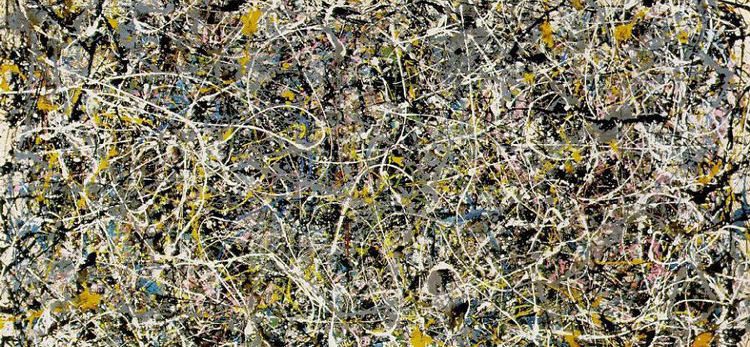
Jackson Pollock, “Number one”, 1950When maths explained human behaviour towards art (again)
It's surprising that painting and mathematics, apparently so far apart, have so much in common. If it had already been established that nature (the original artwork and a constant source of inspiration for human beings) follows the golden ratio to the letter, now the beauty of a painting has been linked to the aesthetic attraction we feel towards fractals. A clear example of the unconscious use of fractals is the one that led Pollock to create some of his greatest artworks. He isn't the only one. If we take a close look at certain artworks by Van Gogh or Velázquez, we see those same patterns, though they're more widespread in modern painting.
Andy Warhol por Jack Mitchell [CC BY-SA 4.0]The artist in front of the artwork
We underestimate the power of empathy when we look at art. So, when we stop to look at a painting by William Blake and we know the man behind it, we find ourselves feeling that artwork within the context of its author. This is a solid reason why we all love or hate certain painters. Obviously it doesn't happen with all of them, but our affinity with a series of artworks has a lot to do with the fascination we feel towards the antihero, the tormented soul, the depraved and corrupted genius.
Probablemente, la pintura más famosa del mundo, La Monalisa de Leonardo Da VinciSocial conformity
This reason is far more personal than the previous ones, since it comes straight from what I learned during my student years. In those years studying Social Psychology I was struck by the so-called Asch experiment, one of the best known when it comes to the study of conformity with the group. The experiment consisted of showing two cards, one on the left, one on the right. The one on the left had the reference line, and the one on the right had three lines among which the correct answer was perfectly clear. A group of students was then brought in, hired to act as a pressure group. The study subject or critical subject was repeated with 123 participants, and the result was that 33% ended up giving in to group pressure.
What this experiment reveals is that human beings need to fit in, and that when there's unanimity it's especially hard to disagree with the collective point of view. We're social beings and we need to be part of a community. While it's true that in something as individual as painting this shouldn't happen, it's fairly common for people to accept in public parameters they don't share in private. A white lie?



Comments (1)
Luis Alonso
June 12, 2019Log in to leave your comment. Log in