
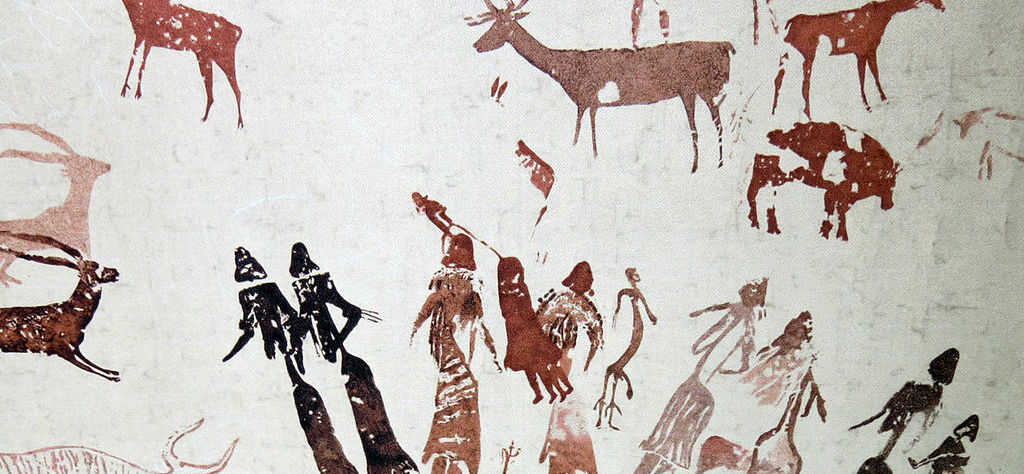
The 21st century is shaping up to be the great dismantler of theories. If only a decade ago it was thought that men were the first artists, since 2013 there's evidence that women could have been the first ones to make art. It comes from the studies carried out by archaeologist Dean Snow at Pennsylvania State University, who found that 75% of the handprints in 8 caves in Spain and France were female. This was possible thanks to the analysis of the length of the finger bones, visibly shorter in women than in men. But that wasn't the only thing he discovered.
Réplica del techo de la cueva de Altamira, expuesta en los jardines del Museo Arqueológico Nacional de España. (Fotografía de Locutus Borg)Men the hunters, women the painters... the logic behind the study of women in prehistoric art
In Snow's words: "In most hunter-gatherer societies, men did the hunting, but often it was the women who hauled the carcasses back to the camp, so they were just as involved in the hunts as the men (…) it was a lot more than a bunch of guys hunting bison".
Ever since we knew prehistoric art existed, art has always been thought to have been "invented" by men, because most of the depictions were of game animals. So it was assumed to be part of, on the one hand, an animist theory (painting the animal to immortalize the soul of the catch), and on the other, a way of recording a feat. There's also been speculation that it could have been a belief that, for them, guaranteed success in future hunts. In fact, the study suggests that a high percentage of the hands doing the painting really were women's.
Impresiones en la Cuevas de las Manos sobre el Río Pinturas en la provincia de Santa Cruz, Argentina. (Fotografía de Mariano Cecowski)Skepticism about Dean Snow's results
After this experiment, the archaeologist has had to face the skepticism of the scientific community. Biologist R. Dale Guthrie, for instance, also carried out a study concluding that whoever made these paintings were teenagers. According to him, that's why what was mainly painted was women and animals, because that's what they had on their minds. What's certain is that this new study reopened the search for the truth, and archaeologist Dave Whitley applauded Guthrie's initiative because it encouraged research on the subject all over again.
Whitley, for his part, claims that the cave paintings were actually the work of shamans who went into a trance. But that idea doesn't rule out women, since most shamans were female, so the controversy and the research are still open.
What do you think? Do you believe the first painters were women, teenagers, men, shamans, or that everyone simply pitched in to bring art into being?



Comments (2)
Alexi José Rojas Guerra
September 16, 2019Pedro Requejo
September 12, 2019yo creo mas bien lo contrario que fueron las primeras modelos.
Log in to leave your comment. Log in