
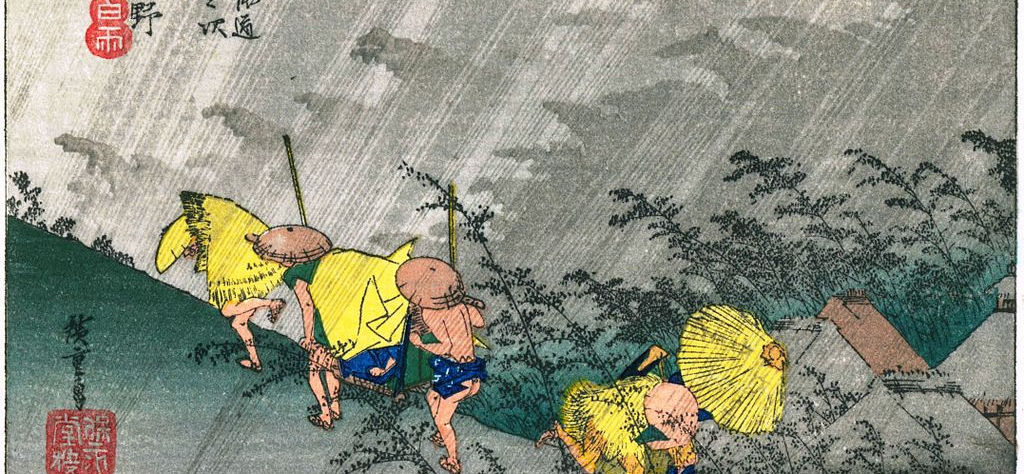
"The man from Edo can get to know the sweet potato of Satsuma and the delicate woman of Kyoto. You go along as if on an outing, you sit down in the shade of a tree and open your bottle of sake. Real travel is about clearing your life of worries", writes Ikku Jippensha in a well known Japanese picaresque novel describing the journey along the Tokaido. One of the greatest records of this excitement for taking to the roads and setting off on a journey, now that the restrictions of the Tokugawa family's iron rule were coming to an end after more than two centuries, is found in the series of prints Las cincuenta y tres etapas de la ruta del Tokaido (around 1832- 1834) by the Japanese master Ando Hiroshige (Edo, 1797- 1858).
That setting was a sort of route, more than 500 kilometres long, linking the city of Edo (present day Tokyo), the usual residence of the shogun, or military governor, with Kyoto, where the emperor normally lived. The road became notably famous at the beginning of the 19th century, largely thanks to the economic prosperity and the time of peace that Japan was enjoying back then. Which is why many of its inhabitants turned into real tourists with ambitions to explore the landscapes the Tokaido had in store for them.
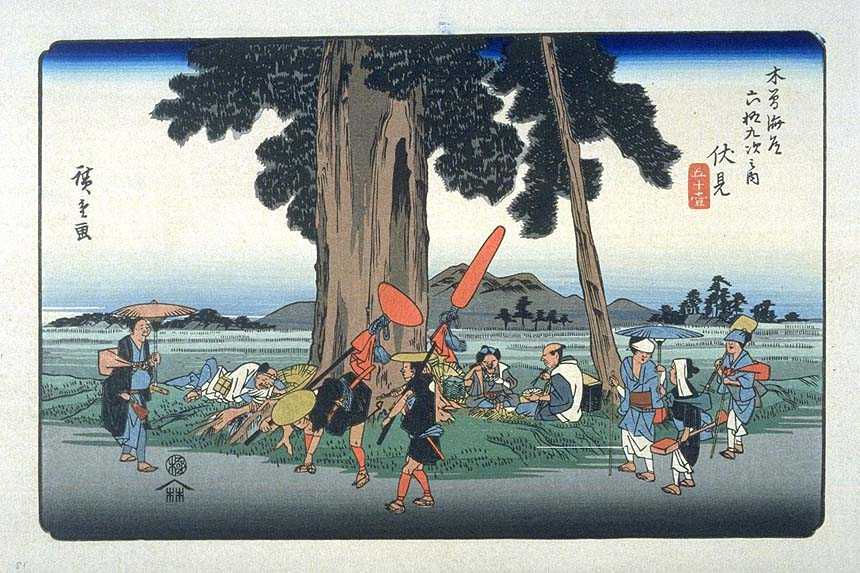
Although this kind of art was sold at the time more as a souvenir or keepsake, let's remember that one of these prints cost no more than a bowl of noodles or a pair of sandals, the truth is that their rise in value and their undeniable influence on much of what art did afterwards have raised them to the status of artworks of incalculable value.
Hiroshige came from a family of low ranking samurai and spent almost his whole life in the shogun's immense palace. Before devoting himself entirely to prints, he served as a captain in the fire brigade for over two decades. His start in printmaking centred on the usual portraits of actors and courtesans, and later he made the Tokaido series mentioned above, with more than 800 views, along with other long series on the city of Edo, close to 1000 renderings.
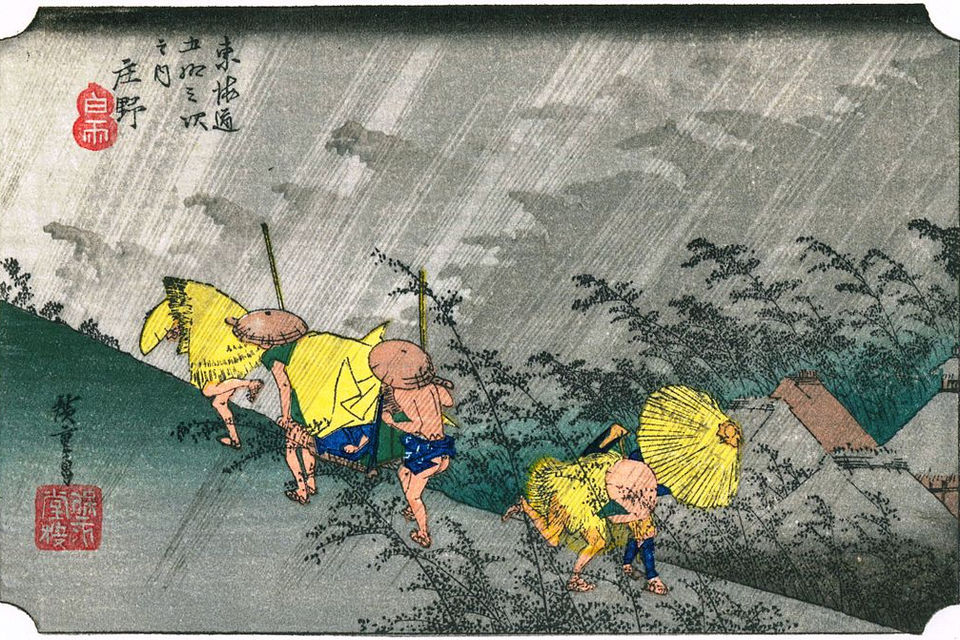
The artist, like many of his Japanese colleagues, shows symbols instead of depicting the object itself. This way the line takes on such force that it wraps the viewer up, together with its colours, in a kind of hazy image, drawing them with an intimate subtlety towards something imagined. To do this he used the technique known as bokashi, in which a cloth soaked in colour was pressed on the block with more or less force depending on the desired intensity of colour. That is what determines the different tones.
Hiroshige liked to show the landscape covered by a layer of snow or blurred by a curtain of rain. The way he depicted the hours of the day, the seasons and the atmospheres in his prints meant they were not just kept as souvenirs of a journey made far too long ago, but went beyond that distance and that space to leave us in the arms of meditation. Perhaps that is why they so caught the eye of the Impressionists. That ability to create an atmosphere in which the laws of perspective are abandoned so that the figures float weightlessly is an effect that both they and the Cubists tried to imitate, in their attempts to do away with dimensions.
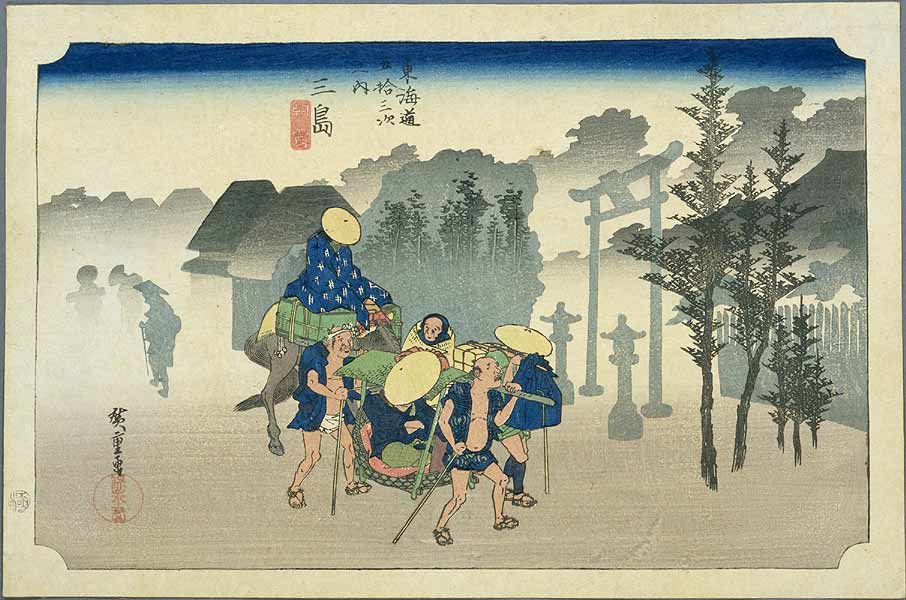
For example, in Niebla matinal (1832- 1834) we see one of the main features of this kind of print: the only figures in focus are the ones in the foreground. The rest, the trees, the gate, the rooftops and the walkers in the background, are reduced to silhouettes in a single tone of colour. The atmosphere is misty, the light diffuse. For the Japanese, nature was full of deities and spirits whose protection and help they asked for at the Shinto shrines dotted along the road. Of Mishima, the town the scene in the print comes from, only a few blurred buildings appear on the left.
The usual way to do the Tokaido road was on foot. There was, however, the possibility of covering it on horseback or in small wicker litters, carried on the shoulders of porters, in which the traveller had to sit hunched over with their legs crossed. That is what we see in the print. Since the kimonos worn by men and women were very similar, and the travellers, for some reason that escapes us, have their faces covered, we cannot even tell what sex they are. The care taken to hide them gives off an air of mystery. Not so for the porters, who could end up paying with their own lives if the person they were carrying fell to the ground.
In the print we can also appreciate that weightlessness of the figures mentioned earlier, along with the nostalgic feel of the monochrome tones in the background. Especially with the three pilgrims on the left, where with simple outlines the artist seems to want to send them, like shadows, into memory. Below them Hiroshige wrote his name in Japanese characters, next to the publisher's red seal.
Comments (0)
Log in to leave your comment. Log in