
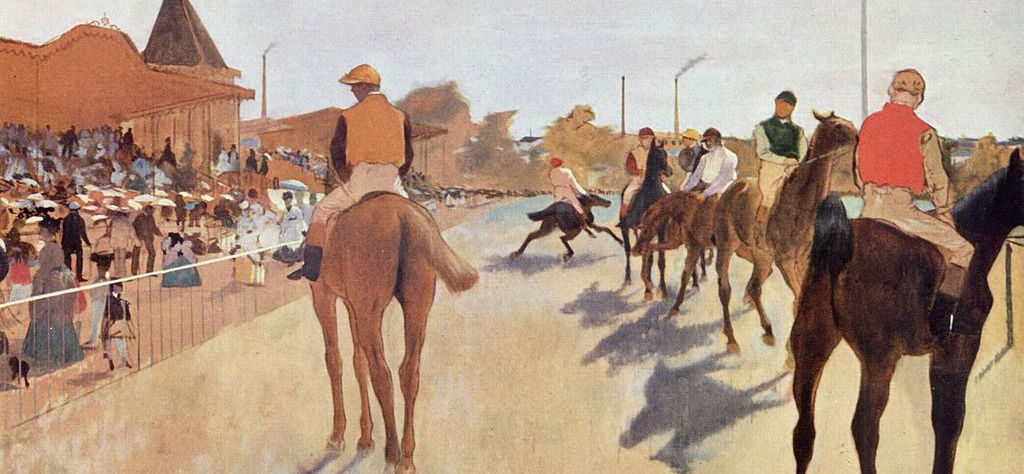
Born into a well-off Parisian family, Edgar Degas (Paris, 1834- 1917) decided to put his law studies at the Sorbonne on hold to devote himself to art. From 1856 to 1859 he travelled through Italy discovering the Renaissance masters, and on his return he threw himself into Paris, never to move away again. There he set about gathering into his compositions a great variety of subjects from the urban life of Paris, the capital of art. One of them was horse racing, a tradition that appeared in England at the end of the 18th century and which, in the 1820s, was taken up in France by artists such as Delacroix and Bonington.
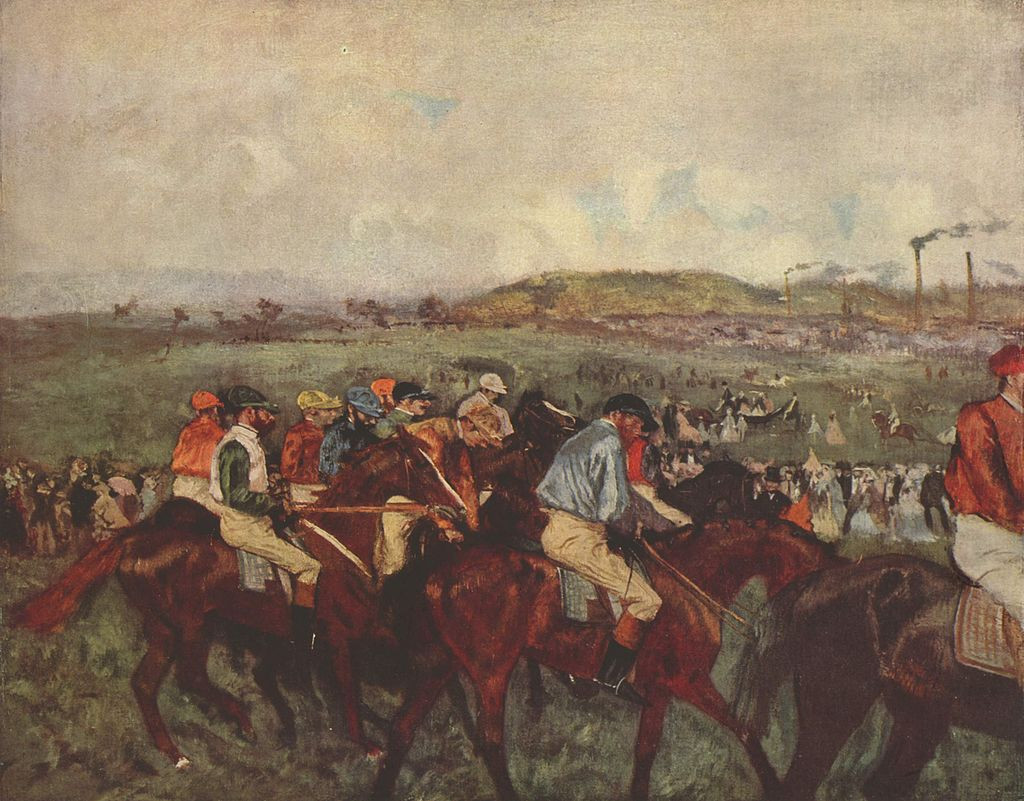
Horse racing had become a very popular activity by the middle of the 19th century, and racecourses were places of intense social life. Degas, for his part, found in them new possibilities for going deeper into the study of form, movement and colour display. The Frenchman also brought his own compositional and iconographic inventions to the depiction of the races, dropping the traditional framing in favour of an off-centre approach. In this way he managed to reflect the new laws of instantaneity that set the style of his time, and he treated the subject of the rider within a modern frame.
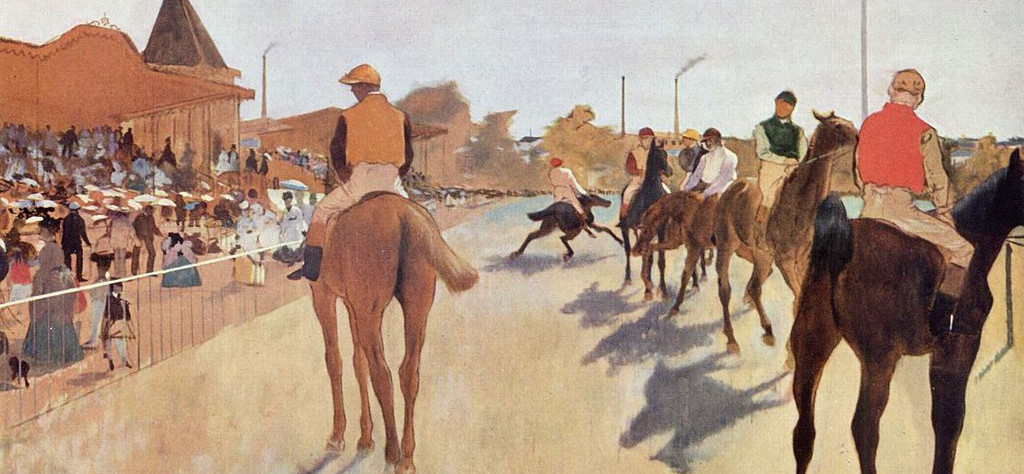
In this series in particular, what stands out is the brilliant range of colour Degas uses, which gives a vivid, exotic result and says a great deal about his reputation as an outstanding colourist. Most of these canvases are done in pastel, a technique Degas used a great deal and which let him better capture the movement and fleetingness of his scenes, something he was so keen to get right.
The painting El desfile, also known as Caballos ante las gradas, (1866- 1868) is one of the first he made on the subject. In it he conveys the atmosphere of the racecourse, where only the restlessness of the last thoroughbred hints that the race is about to start. As in almost all the artworks in this series, Degas gives pride of place to light and drawing, bringing out the silhouettes of the jockeys and their mounts rather than the race itself. In his final years he painted Carreras de caballos en un paisaje (1894). To achieve it he drew on his earlier pieces, and the result came more from memory than from a scene the artist observed from life.
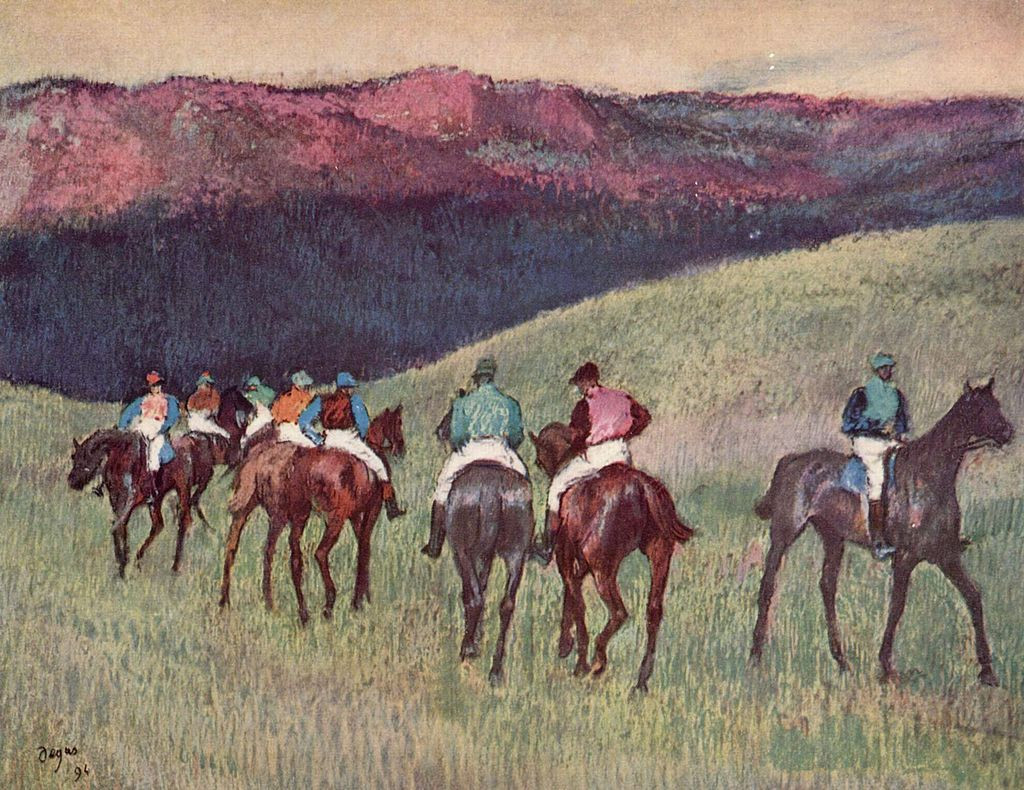
Degas took on the influence of Ingres's finished drawing and was especially interested in the human body, movement, photography and Japanese prints. These tastes brought him close to the impressionist group, with whom he exhibited as many as seven times. One of the most striking aspects of the Frenchman's work is surely the variations on a single theme, a consequence of his fondness for contemplating and reproducing the rhythm and the postures of people and animals. His paintings of ballet dancers or horse races are clear examples of this.

Comments (0)
Log in to leave your comment. Log in