
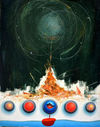
Goethe illustrated one of his works, Contributions to Optics (1791), with the drawing of an eye surrounded by clouds, ringed by a rainbow and struck by a few rays of light. The eye takes the place of the sun in a sunrise and, in the foreground, he places two instruments used for optical analysis: a magnifying glass and a prism. Perhaps this allegorical landscape was a self-portrait of his eye, the eye of a meticulous observer.
Johann Wolfgang von Goethe (Frankfurt am Main, 1749- Weimar, 1832), poet, novelist, playwright, scientist and painter too, began to study the nature and perception of colours around 1790. Twenty years later he published his most important contribution to the world of art, and the one he was proudest of: Teoría de los colores (1810). An essential text for understanding the revolution that the phenomenon of light went through at the beginning of the 19th century. Its pages contain some of the first and most precise definitions of the behaviour of light, such as coloured shadows, refraction or achromatism.
Su planteamiento rechazó los enunciados de Newton sobre el color por estimarlos demasiado mecanicistas. Goethe proponía explicar la experiencia del color mediante una unión necesaria entre factores subjetivos y objetivos. Esto supone que el proceso de percepción involucra no sólo al objeto que es percibido, sino también al individuo que interpreta lo que ve.In the same way, he challenged the accepted idea about the origin of colour. Goethe did not believe that colours were the result of a beam of white light being broken up by a prism. He argued that colour is born in the polarity between light and darkness, and not in the former alone. Because only from the combination of the two does the third factor arise, the one he called turbidity, where he understood the chromatic manifestation to take place.
He did, however, find other theories useful, ones that had already looked at these tensions between light and shadow, such as those of Aristotle or Leonardo da Vinci. From the latter especially, his notions about the perception of atmospheric colour. Goethe also discovered the colours produced in different atmospheric circumstances: on foggy days, at sunrise or sunset, the blue of the sky, more indigo on the peaks than in the valleys under the influence of the relationship between the mist in the air and daylight, or the peculiarities of smoke, which against a dark background looks reddish and against a light one, cerulean.
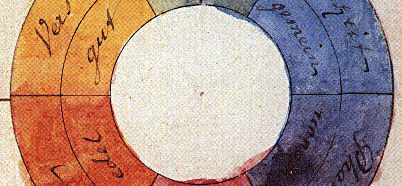
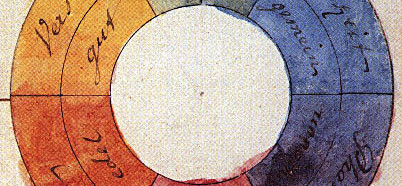
In his circles of complementary colours he revealed a new light, another kind of colour, where black was already something more than the absence of light, and he made each colour face precisely its opposite.
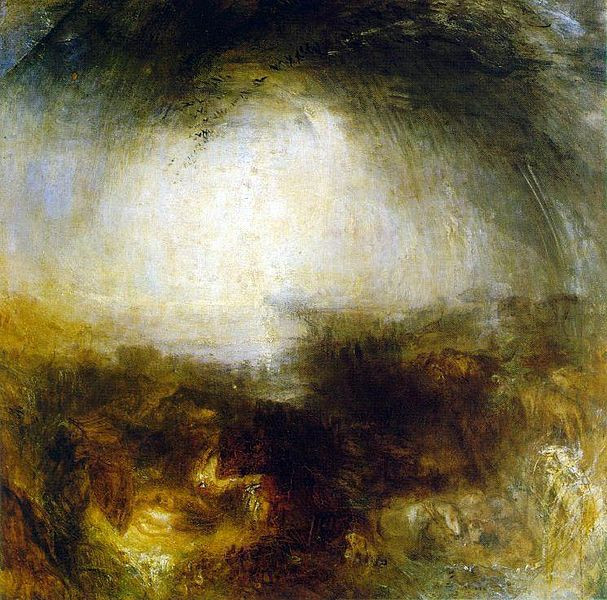
Finally, his sensory reasoning about light pushed him to link colour with emotion. We are talking about those chromatic sensations that had such an impact on the Romantics. On the brilliant William Turner, for example, and that still matter in contemporary art.
Comments (0)
Log in to leave your comment. Log in