
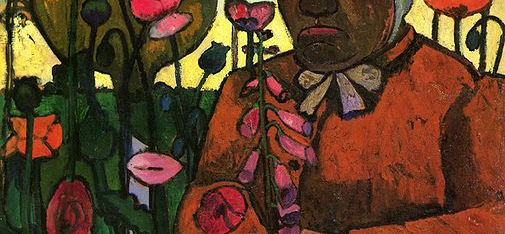
Lost in her thoughts, an old woman holds a foxglove firmly in her hand. She sits right on the edge of the picture plane, her back to a field of poppies and to what looks like an upturned bottle. The composition hangs on the bluntness of the figures and the colour. This artwork was painted by Paula Modersohn- Becker in the last year of her life, in 1907, and the simplification of colour and form, along with the emphasis given to line, already anticipated the roots of German expressionism.
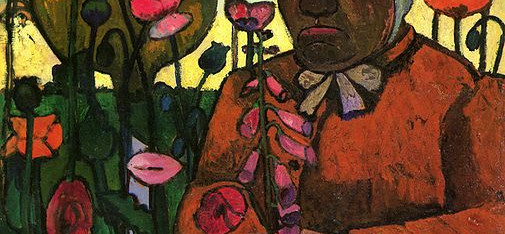
In fact, her painting, an heir to early Gothic and to Egyptian art, amounted to a genuine process of research into the power of simplifying forms. On that basis she built a very particular style that brought together schematic appearances, a certain stillness and colours which, born of reality, are intensified. A language that contributed to the expansion of modern art, but for which history has not reserved a prominent place.
Paula Modersohn- Becker (Dresden, 1876- Worpswede, 1907) was a highly unconventional artist whose short, turbulent life was shaped by an unstable marriage, the struggle to live off her work and an early death at 31, after giving birth to her first and only daughter, Matilde.
She began her training at 20, well outside the norm followed by the women of her time. In September 1898 she moved to Worpswede, north of Bremen, a place that made a deep impression on her for its landscape, its colours, its solitude and, above all, for the artists' colony settled there, to attend the painting and drawing classes given by Fritz Mackensen. During that time she became friends with Heinrich Vogeler, Clara Westhoff, Rainer María Rilke and Otto Modersohn, whom she married in 1901. And it was there too that she found her own path as an artist.
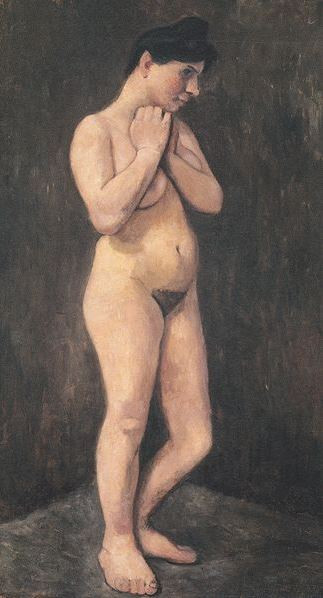
Her proposal, however, was not understood and drew harsh criticism. So, between 1900 and 1907, she travelled several times to Paris, where she studied at the Académie Colarossi and at the School of Fine Arts. She also came into contact with the avant-gardes and was strongly influenced by the work of Van Gogh, Gauguin and Cézanne.
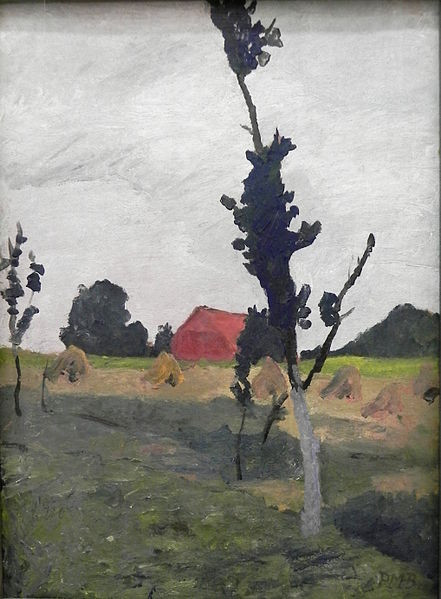
So she gradually reduced the figures of her women and children and the elements of her landscapes and still lifes to basic forms. At the same time she sought harmony with nature in order to give expression to the essential features of the individual and of objects, steering clear of idealising compositions.
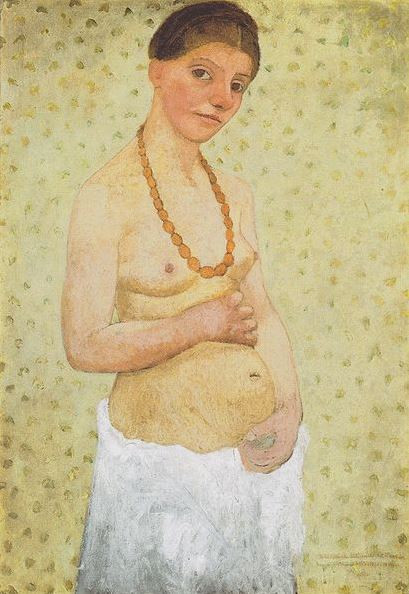
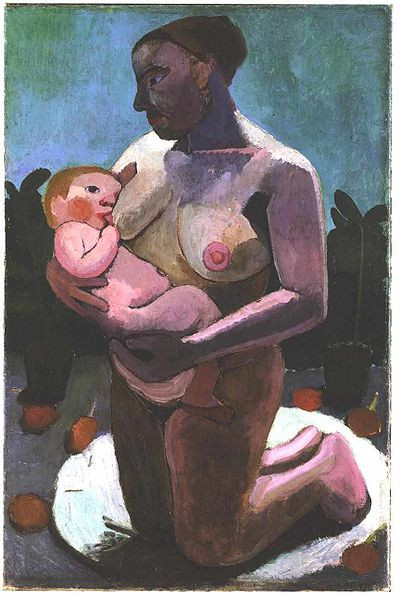
But if there was one thing in her painting that scandalised her contemporaries, it was the reinterpretation she made of the female nude, conceived as pure artistic matter. In some paintings, moreover, the nude merges with the self-portrait, becoming an expression of self-knowledge. Her alternative treatment of motherhood also stands out, again with a certain autobiographical streak. And she was, in fact, the first artist to portray herself naked.
In almost 10 years, Paula Modersohn- Becker created more than 700 paintings, leaving an artistic legacy that would inspire many other painters. Female artists in particular, from Frida Kahlo to Cindy Sherman.
Comments (0)
Log in to leave your comment. Log in