
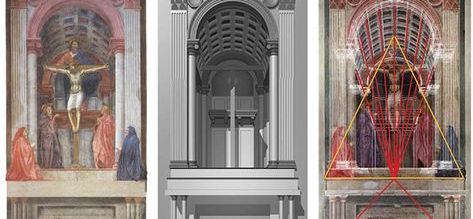
Paradoxically, one of the most important inventions in the history of painting is the work of an architect, Filippo Brunelleschi. He was the one who laid the foundations of the method that would allow visual artists to reproduce figures and objects just as the human eye perceives them. We're talking about the origin of linear perspective.
The first artwork in which the revolutionary laws set out by Brunelleschi (Florence, 1377-1446) were put into practice was Masaccio's La Trinidad (1426-1428), in the Florentine church of Santa Maria Novella.
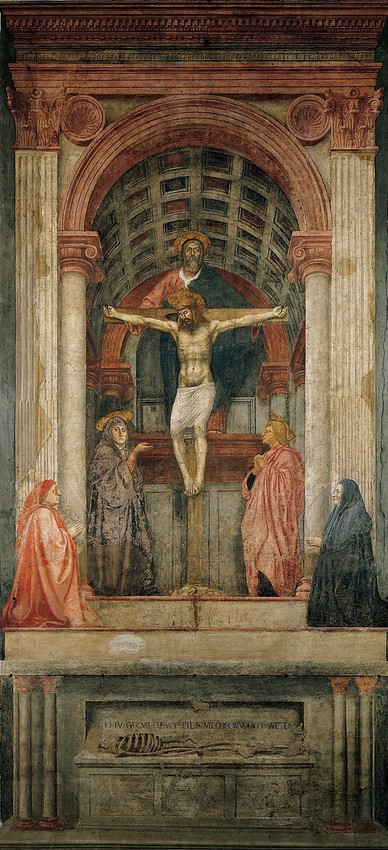
The scene recreates, inside a chapel, the Christian dogma of the Holy Trinity. The centre of the fresco is taken up by Christ on the cross and, at the back, God the Father and the Holy Spirit in the form of a dove make their appearance. On either side of the main figures are the Virgin Mary and Saint John and, placed one step below the imaginary chapel, the figures of the donors, supposedly members of the Lenzi family.
The composition is completed by the sarcophagus at the bottom, a reminder of how fleeting earthly things are, and by the architecture in which the scene unfolds. Of that architecture, the coffered vault stands out, along with the arch supported on two Ionic columns which is in turn framed by two Corinthian pilasters with pink capitals. In fact, the formal language of the painted architecture bears a resemblance to the buildings Brunelleschi put up in Florence, which is why it's thought that the architect may have acted as artistic adviser on the making of the painting.
To achieve that depth that makes it look real to the viewer's eye, Masaccio (San Giovanni Valdarno, 1401 - Rome, 1428) used a precise mathematical calculation that allowed him to reproduce every figure according to its position in space. He also used a complex web of auxiliary lines, which can still be made out today under the layers of colour. All those lines spring from a central vanishing point that the Italian artist skilfully placed at the ideal eye level for the observer, that is, on the lower step.
Also relevant is the chromatic combination of blues and reds, with the intensity of the outlines graded, giving the painting dynamism and heightening that depth created by the trick of drawing the architecture in perspective.
To reach that three-dimensionality, Masaccio had to introduce changes never conceived of before, such as not making the non-divine figures smaller to reflect their place in the theocratic hierarchy. In this way he broke away from the flat perspective of the Middle Ages, which made the dimensions and proportions of the elements in a painting depend on their ideological importance. Although the pyramidal structure governing the composition, which also helps to reinforce the depth, does underline that theocratic order.
Well into the 19th century, painting was still governed by the laws of scientific perspective. That shows the extraordinary scale of the invention. Without a doubt, one of the great artistic milestones of all time.

Comments (7)
Bzcenci
February 9, 2023Bzcenci
February 9, 2023cristina
September 26, 2020nikita
July 15, 2020oigan alguien sabe a que ciencias evoluciono la perspectiva del dibujo tecnico muchas gracias
si alguien sabe responder a mi correo muchas gracias que pena necesito esta respuesta para hoy muchas gracias que pena
Angel
June 2, 2020Eliana Martínez
November 28, 2019salvador damar
January 12, 2020Log in to leave your comment. Log in