
For some years now monumental public sculpture has been gaining more and more importance. Original and controversial artists such as Robert Indiana, Fernando Botero, Murakami, Jaume Plensa, Koons or Bourgeois have become examples of the rise and the quality of public sculpture today. Sculptures that occupy, for a limited time or permanently, the streets and squares of big cities. For some years now the big cities have been trying to bring exhibitions of monumental sculpture by well known artists to their streets.
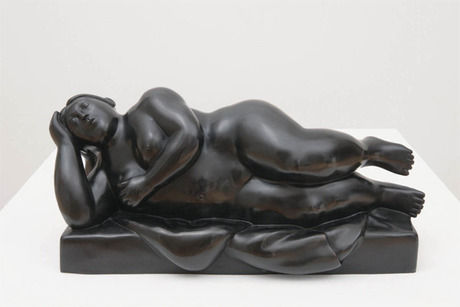
Back in 1994 the exhibition of Fernando Botero's sculptures already caused great interest in Madrid. Fernando Botero is considered the most highly valued living Latin American artist in the world and he moves between his famous sculpture studios in Pietra Santa, Italy and his painting studios in Paris and New York, and he also devotes some days of the year to drawing in Zihuatanejo, Mexico and Rionegro, in Colombia. His artworks have been seen in museums in Mexico, Sao Paulo in Brazil, Pietra Santa and Assisi in Italy, Santiago de Chile, Bogotá and Medellín in Colombia, Bilbao in Spain, Bielefeld in Germany and, as we have already explained, in the Chinese cities of Beijing at the National Museum of China and Shanghai at the China Art Museum. Among his best known sculptures are Man Walking, an 11 foot high figure walking over another man lying down, Reclining Woman, a woman of Rubensesque proportions in a "maja desnuda" pose, or the well known El caballo from 2005.
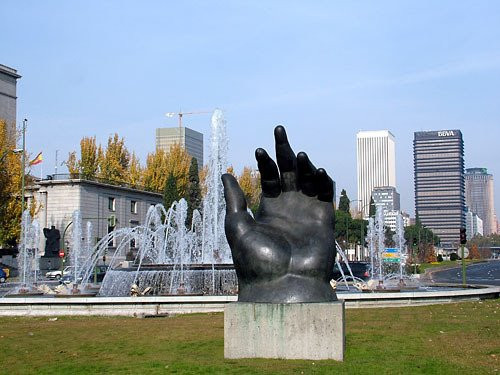
Of the 21 pieces that made up the Botero exhibition in Madrid, five sculptures stayed. La Mujer con Espejo, which stayed in Madrid's Plaza de Colón, was given to the city by the Colombian sculptor just as he had promised when he saw the warm reception it got during the three months the exhibition ran. La Mano was bought by Telefónica, which handed it over to the city for 10 years to be shown where it still stands today, on the Paseo de la Castellana at Nuevos Ministerios. The other three, Rapto de Europa, Caballo and Mujer Recostada, were acquired by the company Aeropuertos Españoles y Navegación Aérea (AENA) and are at Barajas airport in Madrid and Son Sant Joan in Palma de Mallorca.
This year his latest exhibition at the giant China Art Museum in Shanghai, one of the city's most modern symbols, has caused a stir, an expanded version of his show 'Botero in China', which, after its success in Beijing, is back now with new sculptures.
In 2007 the exhibition of the pop artist Robert Clark, known as Robert Indiana, also caused excitement in Madrid, with artworks such as Love, Amor, Art, Imperial love, Love wall and the ten numbers ONE through ZERO. Madrileños could enjoy in their streets his work made up of short words like love, amor and art and numbers turned into spectacular installations. Symbols and words painted in the bright colours of pop art that try to portray American culture and life with irony. His artworks have been shown in places such as Sixth Avenue in New York, the E. W. Fairchild-Martindale Library on the Asa Packer campus at Lehigh University, LOVE Park in Philadelphia, the Plaza del Sagrado Corazón in Bilbao, Taipei 101, the Shinjuku district in Tokyo, the Hotel XIXe Siecle in Montreal or the Israel Museum with the word ahava (love in Hebrew).
The Barcelona sculptor Jaume Plensa also stands out, who held his first exhibition in Barcelona in 1980, and since then has lived and worked, as well as in Barcelona, in Berlin, Brussels, England, France and the United States. The artist began to make a name for himself when in 2011 a large selection of Plensa's sculptures was installed both indoors and in the gardens at the Yorkshire Sculpture Park in West Bretton, England. A very important part of his work is sculpture in public space in cities in Spain, France, Japan, England, Korea, Germany, Canada and the USA. His pieces have won many prizes and mentions, among them the Marsh Award for excellence in public sculpture, which the artist received in London in 2009 for his work.
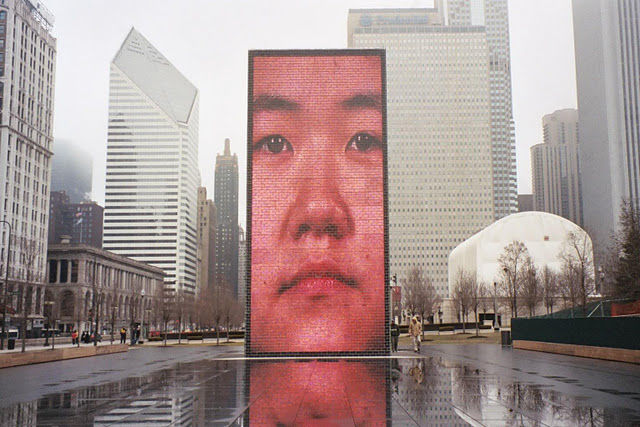
La fuente de la corona, unveiled in Chicago's Millennium Park in 2004, is one of Plensa's biggest projects and, without a doubt, one of his most brilliant. The work led to many commissions, adding to the list of Jaume Plensa's artworks in public spaces, up to the most recent ones, Roots (2014), installed in the Toranomon district in Tokyo.
Jaume Plensa has received numerous national and international distinctions, including the Chevalier des Arts et des Lettres medal, awarded by the French Ministry of Culture in 1993, and the National Fine Arts Prize of the Government of Catalonia in 1997. In 2005 he was made an honorary doctor by the School of the Art Institute of Chicago. In Spain he received the National Fine Arts Prize in 2012 and the prestigious Velázquez Prize for the Arts in 2013.
Plensa shows his work regularly in galleries and museums in Europe, the United States and Asia. Exhibitions such as the one organised at the Fundació Joan Miró in Barcelona in 1996, which travelled to the Galerie Nationale du Jeu de Paume in Paris and the Malmö Konsthall (Sweden) the following year.
In our country too the exhibition Jeff Koons Retrospective, which could be enjoyed in 2015 at the Guggenheim Museum Bilbao, came as a big surprise. An exhibition organised by the Whitney Museum of American Art, New York, in collaboration with the Centre Pompidou and the Guggenheim Museum Bilbao. Jeff Koons became famous in the mid 1980s, as a member of a generation of artists who explored the meaning of art in an age saturated by the media.
His sculptural elements include vacuum cleaners in plexiglass cases, basketballs floating in glass tanks, porcelain figurines of Michael Jackson and the Pink Panther, and glass panels with images of himself making love to his then wife, Ilona Staller, known as the outrageous Cicciolina.
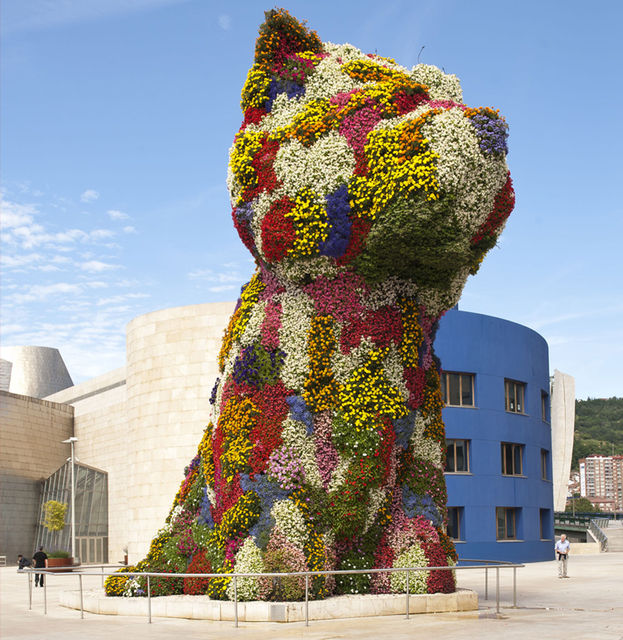
As for monumental sculpture, Puppy stands out, for which he used a sophisticated computer model to create a work that refers back to a classical 18th century European garden. The giant West Highland terrier completely covered in flowering plants is a monument to sentimentality. With its imposing size Puppy, majestic and sturdy at once, stood guard at the doors of the Museum and drew admiration from the exhibition's visitors.
Another of his best known artworks is Balloon dog, which depicts an inflated balloon dog in orange, 12 feet high and made of steel. €43,400,000 is the figure this piece reached at a Christie's auction, breaking the world record for the most expensive artwork by a living artist ever sold.
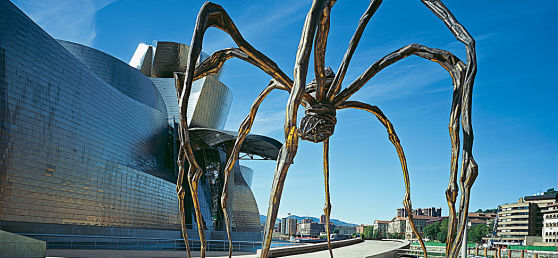
Another outstanding artist of monumental sculpture is Louise Bourgeois, whose work was also shown in 2001-2002 at the Guggenheim Museum Bilbao and who created a rich and innovative body of work that crossed paths with some of the main avant-garde movements of the 20th century, such as Surrealism, Abstract Expressionism and Post-Minimalism, without ever giving up her own creative vision. Although Bourgeois's work takes in painting, drawing, printmaking and performance, the artist is best known for her sculptures, whether intimate or monumental, in which she used a range of materials such as wood, bronze, latex, marble and fabric.
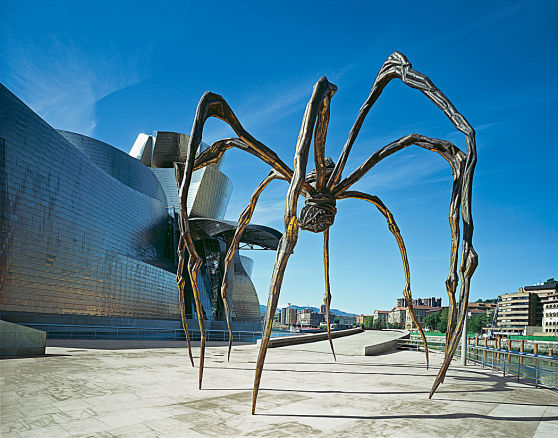
One of Bourgeois's most ambitious sculptures is Mamá (Maman), almost 9 metres high, and it belongs to a series inspired by the spider, a motif that first appeared in several drawings the artist made in the 1940s and took a central place in her work during the 1990s. The spiders, which Bourgeois presents as a tribute to her mother, who was a weaver, bring out the double nature of motherhood: the mother is protector and predator at the same time. A gigantic spider, standing on legs that look like Gothic arches and that work at once as a cage and as a protective shelter for a sac full of eggs precariously attached to its abdomen.
Another artist who stands out for the originality of his sculptures is Takashi Murakami, one of the Japanese artists with the greatest reach on the international art scene. An artist who plays with contrasts and double readings: East and West, past and present, high art and low culture, humour and social criticism. In November 2003, ArtNews reported Murakami's work as one of the most sought after in the world. Hiropon, a satirical life size sculpture of an anime character with gigantic lactating breasts, sold for 427,500 dollars at Christie's auction house in May 2002. His work has kept rising in value and in May 2008 My Lonesome Cowboy (1998), an anime inspired sculpture of a boy masturbating, sold for 13.5 million dollars at Sotheby's. In September 2010, Murakami became the third contemporary artist, and the first Japanese one, to exhibit his work at the Palace of Versailles in France, filling 15 spaces and the park with his sculptures, paintings, a decorative carpet and lamps.
In 2009, also at the Guggenheim Museum Bilbao, we could enjoy the broadest retrospective devoted to this artist to date. More than 90 artworks in different media such as painting, sculpture, installation and film run through the ongoing evolution of Murakami's alter ego, DOB, his figurative projects inspired by the otaku of the late 1990s and the range of products from Kaikai Kiki Co., Ltd. that span Takashi Murakami's whole career.
And here we leave you with a really interesting video about Plensa's work:
Comments (0)
Log in to leave your comment. Log in