
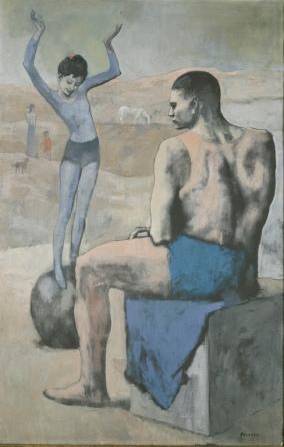
As part of its Invited Work programme, the Museo del Prado (Madrid, Spain) presents Acrobat on a Ball, one of the most important works from Picasso's Rose Period. It will be on display at the Prado for three months and represents the first occasion in forty years on which the painting has left the Pushkin Museum as well as its first presentation in Spain.
Following the intense and melancholy expressivity of the Blue Period, during his next phase, which began in Paris in 1905, Picasso focused on some of the key visual aspects of painting: precise and energetic line; closed, perfect form; and a pronounced sense of volume. His investigations led him to take a direction very different to that of the contemporary young French painters who were fascinated by the violent chromatism of Fauvism.
Picasso studied the composition of Acrobat on a Ball in various preparatory drawings. It reveals a meditated balance between the lightness of the young female acrobat and the solid weight of the athlete. The sphere and the cube on which they are respectively supported emphasise those characteristics and hence the contrast between the two figures. In addition, the sphere and cube are geometrical solids that have been associated with the concepts of perfection and stability since the classical, Platonic tradition.
Date: until December 18.
Place: the Museo del Prado. Paseo del Prado s/n. 28014. Madrid. Spain.
Opening hours: from Tuesday to Sunday from 9am to 8pm.

CAC de Málaga hosts the largest exhibition of Vik Muniz' work ever held in Europe
through December 2

Van Gogh to Kandinsky: Symbolist Landscape in Europe 1880-1910
from July 14 to October 14.



