
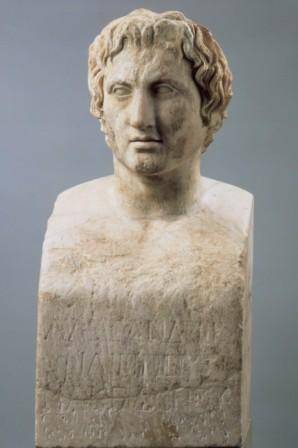
The Louvre Museum (Paris, France) presents an exhibition curated by a Greek and French team of specialists, which brings together five hundred works tracing the history of ancient Macedonia from the fifteenth century B.C. up to the Roman Empire. Visitors will be able to explore the rich artistic heritage of northern Greece, many of whose treasures are still little known to the general public, due to the relatively recent nature of archaeological discoveries in this area.
It was not until 1977, when several royal sepulchral monuments were unearthed at Vergina, among them the unopened tomb of Philip II, Alexander the Great's father, that the full archaeological potential of this region was realized. Further excavations at this prestigious site, now identified with Aegae, the first capital of ancient Macedonia, resulted in a number of other important discoveries, including a puzzling burial site revealed in 2008, which will in all likelihood entail revisions in our knowledge of ancient history.
The exhibition takes as its theme the glorious past of this kingdom, impressive in its reach at the height of its prominence. It also provides an opportunity to explore the nature of royal burial sites in northern Greece at the time of these rulers: the wondrous artifacts unearthed, which had been protected by tumuli, provide unique insights into the virtuosity of this period’s artists.
Date: until January 16.
Location: Mo Palais-Royal /musée du Louvre, 75001 Paris, France
Opening hours: Wednesdays and Fridays from 9am to 10pm. Mondays, Thursdays, Saturdays and Sundays from 9am to 6pm.
See some of the artifacts in the following slideshow:

CAC de Málaga hosts the largest exhibition of Vik Muniz' work ever held in Europe
through December 2

Van Gogh to Kandinsky: Symbolist Landscape in Europe 1880-1910
from July 14 to October 14.



