
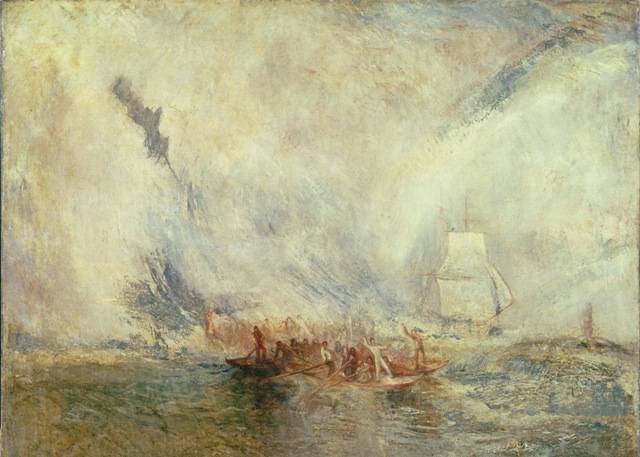
For the first time in Poland, the National Museum in Krakow presents an exhibition of works by William Turner, greatest of the English Romantic painters and precursor of Impressionism and Symbolism, an artist who, in his landscapes of water and clouds, came close to abstract painting.
Compiled by the Bucerius Kunst Forum in Hamburg, the exhibition consists of eighty-four of Turner's paintings of the elements, earth, air, fire and water. The works come from the Tate Gallery and several other English and American collections.
William Turner left well nigh thirty thousand works in all, most of which are sketches of landscapes. His concept of the genre was based on the theories of the French painter Pierre-Henri de Valenciennes (1750-1819), the first artist to paint landscapes directly from nature. De Valenciennes conceived the notion of the 'landscape portrait', an idea which resounded widely in artistic circles, prompting artists to paint real places, rather than composing imaginary landscapes. English landscape painting was an embodiment, glorification and metaphor of Nature and it underscored humankind’s place within the cosmos.
The exhibition's curators have assigned the drawings and paintings on show in line with the four elements, earth, air, fire and water, and with their fusion. This last category encompasses paintings within which the elements are juxtaposed and interwoven. These are compositions where Turner renounced a spatial division creating separate parts. Here, the evolvement is centric; the picture springs outward in all directions from the heart of the painting. In his later works, it swirls.
Date: until January 8.
Location: National Museum in Krakow. al. 3 Maja 1, 30-062 Krakow. Poland.
Opening hours: from Tuesday to Saturday from 10am to 6pm. Sundays from 10am to 4pm.
See some of the works in the following slideshow:

CAC de Málaga hosts the largest exhibition of Vik Muniz' work ever held in Europe
through December 2

Van Gogh to Kandinsky: Symbolist Landscape in Europe 1880-1910
from July 14 to October 14.



