© All rights reserved
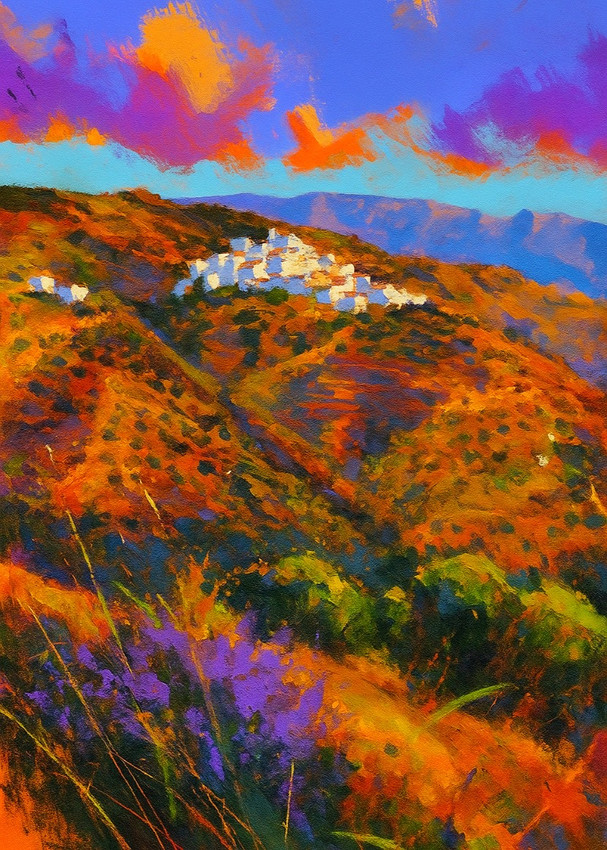
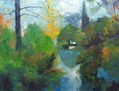
En Curumbela, el pequeño pueblo blanco emerge como un latido suspendido en la montaña. Las casas, agrupadas en lo alto de la loma, se convierten en un núcleo de luz frente a la intensidad del paisaje que las rodea.
La composición conduce la mirada desde el primer plano vibrante —manchas de violetas, verdes y ocres encendidos— hasta la arquitectura blanca que corona la colina. El cielo, cargado de naranjas y azules eléctricos, no describe un momento concreto del día, sino una atmósfera emocional donde la tierra parece arder en color.
La pincelada es gestual y decidida, construyendo el relieve sin caer en el detalle minucioso. Más que representar fielmente el pueblo, la obra captura su esencia: aislamiento, silencio, resistencia y pertenencia.
Curumbela no aparece como simple geografía, sino como memoria viva del territorio. Un fragmento de la Axarquía convertido en símbolo, donde luz y montaña dialogan con intensidad casi mística.
🇬🇧 English
In Curumbela, the small white village emerges like a suspended heartbeat in the mountains. The clustered houses at the top of the hill become a core of light against the intensity of the surrounding landscape.
The composition guides the viewer’s gaze from the vibrant foreground —strokes of violet, green and burning ochres— toward the white architecture crowning the ridge. The sky, charged with oranges and electric blues, does not depict a specific moment of the day, but rather an emotional atmosphere where the land seems to burn with color.
The brushwork is gestural and confident, building relief without relying on meticulous detail. Rather than faithfully representing the village, the painting captures its essence: isolation, silence, resilience and belonging.
Curumbela does not appear as mere geography, but as living memory of the territory — a fragment of the Axarquía transformed into symbol, where light and mountain engage in an almost mystical dialogue.
⸻
🇩🇪 Deutsch
In Curumbela erscheint das kleine weiße Dorf wie ein schwebender Herzschlag in den Bergen. Die auf dem Hügel gruppierten Häuser werden zu einem Lichtkern im Kontrast zur Intensität der umgebenden Landschaft.
Die Komposition führt den Blick vom vibrierenden Vordergrund —Violett-, Grün- und glühende Ockertöne— hin zur weißen Architektur, die den Höhenzug krönt. Der Himmel, durchzogen von Orangetönen und elektrischen Blaunuancen, beschreibt keinen konkreten Tagesmoment, sondern eine emotionale Atmosphäre, in der das Land selbst in Farbe zu brennen scheint.
Der Pinselstrich ist gestisch und entschlossen und formt das Relief, ohne sich in detaillierter Ausarbeitung zu verlieren. Anstatt das Dorf naturgetreu darzustellen, fängt das Werk sein Wesen ein: Isolation, Stille, Widerstandskraft und Zugehörigkeit.
Curumbela erscheint nicht als bloße Geografie, sondern als lebendige Erinnerung an das Territorium — ein Fragment der Axarquía, das zum Symbol wird, wo Licht und Berg in einen beinahe mystischen Dialog treten.
See more information about Laure De las Moras
 Reviews (0)
 Spain
Spain